Fix It
Sub-Zero Error Codes, Decoded for the Beach
An EC50 is not a verdict — it is a warning, and on this coast it usually points at something cheap. Here is what your display is actually saying.
A Sub-Zero error code in Atlantic Beach is the unit flagging a problem early. EC50 means excessive run time on the refrigerator side, EC40 on the freezer side — near the beach, usually a salt-clogged condenser. Double dashes on a 600-series mean a failed control board. Call (904) 650-0561 or book online; most run-time codes resolve in the $250 to $550 lane.
For Sub-Zero repair in Atlantic Beach or Neptune Beach, call (904) 650-0561 or book online.
What a Sub-Zero error code is — and is not
Modern Sub-Zero® built-ins watch their own vital signs. When run time, temperature, or a circuit drifts out of range, the control board posts a code or a fault state on the display so the problem surfaces before it becomes damage. That is the key thing to understand: a code is an early warning, not a death certificate. The run-time codes especially — EC50, EC40 — are the unit asking for help while the fix is still cheap.
On the beaches, most codes trace to a short list of local causes: a salt-fouled condenser that cannot reject heat, a door gasket hardened by humidity, a fan or board hit by a lightning-season surge, or hard-water scale on the ice side. The code narrows where we look; the diagnosis confirms the cause before any part is named. Reading the model and serial off the tag inside the fresh-food door before you call gets the right parts on the van.
The codes you are most likely to see
Find your code or display state down the left. The likely beach cause and the cost lane it usually sits in are alongside.
| Code / display | What it means | Likely beach cause / lane |
|---|---|---|
| EC50 | Excessive run time, refrigerator side | Salt-clogged condenser, then gasket — $250–$550 |
| EC40 | Excessive run time, freezer side | Freezer condenser airflow and coil — $250–$550 |
| "Vacuum Condenser" light | 600-series (1998–2002) excessive-run prompt | Clean the condenser first — $250–$550 |
| Service light flashing | 600-series general fault — usually a drifted thermistor | Sensor or solenoid check — $250–$1,100 |
| Double dashes ( -- ) | 600-series EEPROM / control board failure | Board repair or replace to serial — $550–$1,100 |
| Dark panel, lights on | BI brownout-locked control board | Surge damage; reset or replace — $550–$1,100 |
House rule: a sealed-system or compressor quote only comes after airflow, electrical, and pressure readings agree. A code points us at a side; the gauges tell us the cause. Specific codes vary by model and generation, so the exact part is confirmed against your serial, not the chart.
EC50 and EC40: the run-time codes, explained
These two are the codes we clear most on the beaches, and they are also the most misunderstood. Both mean the same thing — a sealed system has run far longer than normal trying to hold temperature — with EC50 on the refrigerator side and EC40 on the freezer side. They do not mean the compressor is failing. They mean something is making the compressor work too hard.
The side matters most on a dual-refrigeration unit. A PRO 48 runs two completely separate sealed systems — one compressor and circuit for the fridge, another for the freezer — so an EC40 with no EC50 tells us the fault lives in the freezer half and the refrigerator half can be left untouched. On a single-system box the two codes overlap, and which one logs first is less diagnostic. Reading the side correctly is what keeps a one-system repair from becoming a two-system invoice.
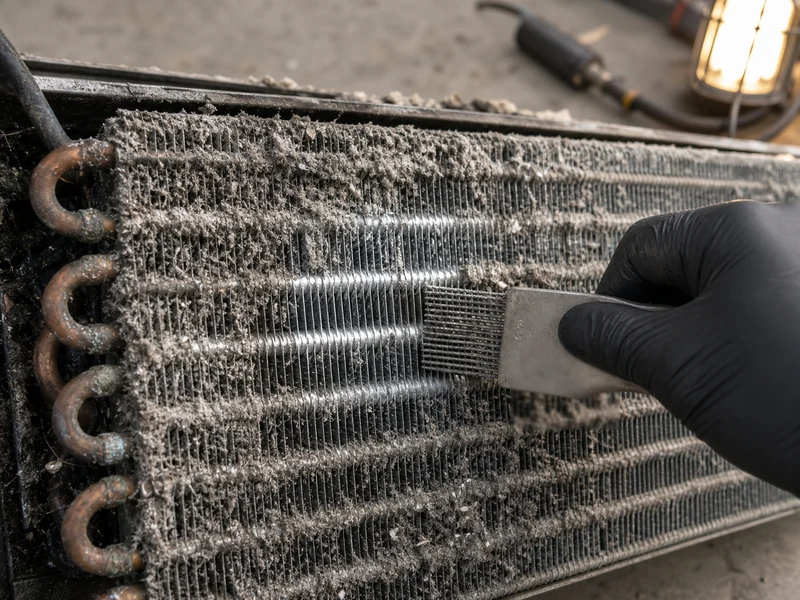
Near the ocean, that something is almost always the condenser. Salt fog drifts through the toe grille, settles on the fins, and glues itself to dust until the coil can no longer shed heat. The compressor runs and runs to make up the difference, the run-time threshold trips, and the code posts. A thorough condenser cleaning — vacuum, fin comb, the works — is frequently the entire repair, in the $250 to $550 lane.
The other usual suspects are a condenser fan that has stalled (often a salt-bound bearing, or a cooked fan triac on a BI board) and a door gasket gone hard, which loads the system with humid beach air. We read airflow, meter the fan and its switch, and run the bill test on the seal before deciding. Ignored, the overrun behind an EC50 can eventually strain a compressor into the $1,000-to-$2,000 lane — which is why catching the code early is the whole point. The reset to try first is on our not-cooling triage page, and the BI-specific version is detailed on the BI series page.
The 600-series warnings: Vacuum Condenser and the service light
The classic 600-series is everywhere in Atlantic Beach — the 1990s and early-2000s remodels of those oceanfront cottages are full of them — and that generation does not speak in EC numbers. It uses words and lights instead, and two of them confuse owners constantly.
- EC50
- Excessive compressor run, refrigerator side. A run-time warning, not a part diagnosis — the board sees the unit ran long but not why.
- EC40
- Excessive compressor run, freezer side. Isolates the failing half on a dual-system PRO 48.
- "Vacuum Condenser" light
- The 600-series ancestor of the EC code, on 1998–2002 boards. Same excessive-run message, worded as an instruction: clean the condenser before the run time strains the compressor. On the beaches that is a salt-felted coil, a $250 to $550 cleaning.
- Service light flashing
- A general 600-series fault flag, not a numbered code — most often a drifted thermistor (temperature sensor) or a solenoid energized past its window on the ice side. The board says "something is off," not which part.
The "Vacuum Condenser" light catches people because it reads like an instruction the unit is giving rather than a fault it is reporting — and in a sense it is both. Treat it exactly like an EC50: pull the toe grille and look at the coil first. A flashing service light is vaguer, so we meter the thermistors against a reference thermometer and check the ice-maker fill before condemning anything. None of these older warnings names a part; they tell us where to start, and the diagnosis names the cause.
Dashes and dark panels: the board faults
Not every fault is a tidy two-letter code. The two most common control faults on this coast show up as a display state instead.
Double dashes on a classic 600-series mean the control board’s EEPROM — the chip that stores the unit’s settings and calibration — has failed. The board can no longer regulate or report temperature, so the display falls back to dashes. It is the defining failure of the 1996–2009 generation. Some boards are rebuildable and some are replace-only, and part revisions matter: a board for one model may not run another. The 600-series detail is on the classic 600 page.
A dark panel with the interior lights still on is the BI-series brownout lock. The lights and the control board sit on different circuits; when a thunderstorm drops power and the utility slams it back, the restoration surge can damage the board while the lights ride through. A clean power-down sometimes clears a confused board — try it before you pay anyone — and when it does not, the board gets replaced against your serial. A whole-home surge device, roughly $900 to $1,200 installed, is cheap insurance against a repeat on this lightning-heavy coast.
What to do when a code appears
A code is a prompt, not a panic. Working through these in order saves a service call when the fix is simple, and shortens the visit when it is not.
- Write down the exact code and when it shows. EC50 versus EC40, a steady display versus a flashing one, dashes versus a dark panel — each points somewhere different. Note the time of day and whether it follows a storm.
- Pull the toe grille and look at the condenser. On an EC50 or EC40, a coil packed with grey salt-bound lint is often the whole story. The grille pops off by hand; a vacuum and soft brush may clear the code with no parts at all.
- Try one clean power-down. Breaker off for five minutes, then back on, gives a confused board a chance to reset. If the code returns, the cause is still there — note that it came back.
- Leave the set points alone and protect the food. Cranking the dial colder masks the problem and adds run time. Hold 38°F up top and 0°F below, and move anything irreplaceable to a cooler if the box is warming.
- Read the model and serial before you call. The tag inside the fresh-food door decides which board revision and parts we load — the single biggest factor in a one-visit fix.
Codes, beach edition
The same code reads differently depending on where the unit sits and which generation it is. These are educational diagnostic scenarios, not customer reviews.
Educational diagnostic scenario, not a customer review
A BI-42SD a block off the ocean in Atlantic Beach threw EC50 every afternoon through July. The owner feared a compressor. The actual cause was a condenser so salt-felted the fresh-food system could not reject heat in the day’s heat, plus a four-year gasket gone hard. A deep coil cleaning, a new OEM seal, and a condenser fan check cleared the code and held 38°F — all in the lowest lanes, no sealed-system work. The code had been an early warning, not a sentence.
Educational diagnostic scenario, not a customer review
A 1999 600-series in a remodeled Selva Marina cottage lit its "Vacuum Condenser" warning and, weeks later, a flashing service light. The owner read both as one dying board and braced for a replacement. In fact they were two separate, cheap stories: the Vacuum Condenser light was a coil packed with years of salt-bound dust, cleared by a deep cleaning, and the service light was a thermistor drifted a few degrees out of spec. A sensor swap and a vacuumed coil — both in the lower lanes — put the unit back on temperature. Because that board generation has scarce, sometimes rebuild-only parts, confirming the model and serial first kept the fix from stalling on a back-ordered board.
One town south the codes read the same on the same built-ins — Neptune Beach rebuilds and oceanfront homes run BI and PRO units we cover the same week, noted on the Neptune Beach page. The maintenance that keeps codes from posting at all is on the salt-air survival guide.
Straight answers
Error-code questions owners actually ask
What does an EC50 code mean on my Sub-Zero?
EC50 is an excessive-compressor-run-time warning on the refrigerator side — the unit has run far longer than normal trying to hold temperature. Near the beach, nine times out of ten the root cause is a salt-clogged condenser the compressor cannot reject heat through, so it never catches up. A torn door gasket or a failed condenser fan triggers the same code. We clear the cause before swapping parts; sometimes a thorough coil cleaning is the entire fix.
Is EC40 different from EC50?
Yes — EC40 flags excessive run time on the freezer side, where EC50 flags the refrigerator side. The logic is the same: the affected sealed system is working too hard for too long. The distinction earns its keep on a dual-refrigeration unit like the PRO 48, where the refrigerator and freezer run on separate compressors and sealed circuits — the code tells us which condenser, evaporator, and fan to open first, and which half to leave alone. On a single-system box the two codes overlap heavily. The usual beach causes are identical either way — fouled coil, weak airflow, or a hardened gasket loading the system.
My older 600-series shows a "Vacuum Condenser" light — is that an error?
It is the 600-series ancestor of the EC code, on the 1998–2002 control boards. "Vacuum Condenser" is the board telling you the compressor has been running long enough that it wants the coil cleaned — the same excessive-run message EC50 carries on newer electronics, just worded as an instruction instead of a number. Treat it the same way: pull the grille and check the condenser before anyone talks about a part. On this coast that light is almost always salt-felted fins, a $250 to $550 cleaning.
A service light is flashing but there is no number — what does that mean?
A flashing service light on the older 600-series is a general fault flag, most often a thermistor — a temperature sensor — that has drifted out of range, or a solenoid held energized past its window on the ice side. It is the board saying "something is off," not naming the part. We meter the sensors against a reference thermometer and check the ice-maker fill before replacing anything; a drifted thermistor sits in the $550 to $1,100 lane, a scaled ice-maker valve much lower.
The panel is completely dark but the interior lights work — is that an error code?
Not a code so much as a dead controller. On BI-series built-ins, a dark panel with the lights still on is the brownout lock — a power outage’s restoration surge scrambled or damaged the control board while the lights, on a separate circuit, stayed lit. Sometimes a clean power-down resets it; often the board is damaged. It is the most common BI failure on this coast after a lightning-season storm.
Can I clear a Sub-Zero error code myself?
Sometimes the display, never the cause. Clearing a code clears the symptom, not the problem behind it. A clean power-down — breaker off for a few minutes, then back on — can wipe a confused board or a stale code, and it is worth trying before you call. But if an EC50 returns within days, the salt-felted coil or failing fan behind it is still there. Resetting without fixing the cause just restarts the clock on the same overrun, and a code that comes back after a proper condenser cleaning is pointing somewhere deeper. The reset steps are on our not-cooling triage page.
Why do beach Sub-Zeros throw run-time codes more than inland ones?
Salt and humidity. Within a few blocks of the dune line, salt fog coats the condenser fins and throttles heat rejection, so the compressor runs longer to hold 38°F and trips EC50 or EC40. High coastal dew points harden door gaskets in three to four years, and a leaking seal loads the system further. Both are documented Atlantic Beach failure modes, and both are why quarterly coil cleaning matters here far more than the manual’s schedule.
Does an error code always mean an expensive repair?
No — and the run-time codes are often the cheapest of all. EC50 and EC40 frequently resolve with a condenser cleaning and an airflow check in the $250 to $550 lane, because the code is a warning before damage, not a death certificate. The expensive outcomes come from ignoring the code until the overrun strains a compressor. Caught early, an error code is the unit doing you a favor.
My ice maker has a service light or flashing indicator — what does it mean?
On 600-series makers, a service light often flags a solenoid energized past its time window — typically the inlet valve held open too long because a scaled screen is starving the fill. On this 14-to-28-grain water that scale is the usual root cause. We test the solenoid electrically and measure fill volume before replacing anything; the full ice-maker diagnosis is on the ice maker repair page.