Models
Sub-Zero Undercounter & UC-15I Repair on the Beaches
The small units do the heavy lifting at a beach house — the island ice machine, the patio drawers, the bar fridge. They also take the worst of the salt and the hardest of the water.
Sub-Zero Atlantic Beach repairs undercounter units — the UC-15I clear-ice machine, refrigerator and freezer drawers, and beverage units — across Atlantic Beach 32233 and Neptune Beach 32266. The local killer is scale: JEA water runs 14 to 28 grains, and the UC-15I runs water continuously over a cold plate. Call (904) 650-0561 or book online; most undercounter repairs run $250 to $1,100.
For Sub-Zero repair in Atlantic Beach or Neptune Beach, call (904) 650-0561 or book online.
Updated June 13, 2026 — by the techs who actually service these units.
What undercounter Sub-Zero units are, and where they live here
Undercounter is the family of compact built-ins that tuck under a 34-inch counter: the UC-15I ice machine, UC refrigerator and freezer drawers, and beverage units. They are the supporting cast of a luxury beach kitchen — the island ice maker for entertaining, the drawer fridge by the cooktop, the bar unit on the porch — and on this coast they earn their keep.
The UC-15I is the headliner. It is the one Sub-Zero® ice machine still in production since 2009, and it makes clear, restaurant-style ice by flowing water continuously over a cold evaporator plate. That design is wonderful for cocktails and brutal for hard water — more water contact than any other unit means more scale, faster.
Around here these units land in the post-2014 rebuilds near Selva Marina and the Atlantic Beach Country Club, in the oceanfront homes on Beach Avenue, and in the summer kitchens and patios that make a beach house a beach house. Outdoor placement adds salt to the scale problem, which is exactly the pairing our salt-air survival guide is built around.
Undercounter symptom, first check, cost lane
Read the symptom down the left. Most undercounter calls on the beaches are scale, salt, or a drain — and they sort into clear lanes.
| What the unit is doing | Where we look first | Cost lane |
|---|---|---|
| UC-15I slowing, ice turning cloudy | Scale on the cold plate and water system | $250–$550 |
| UC-15I no ice, unit running | Inlet valve, pump, then the control | $250–$700 |
| Water pooling under the unit | Gravity drain clog or condensate pump | $250–$550 |
| Drawer fridge running warm | Salt-fouled condenser, then airflow | $250–$550 |
| Drawer icing or sweating | Hardened drawer gasket from humidity | $550–$1,100 |
| Patio unit corroded, struggling | Condenser corrosion plus inside scale | $250–$700 |
The single biggest swing on a UC-15I is descale history. A machine on a three-to-six-month cleaning schedule stays in the cheap lane for years; one left untouched usually drags the whole job up when scale finally reaches the valve and pump.
Why hard water punishes the UC-15I most
Every ice maker in the house meets the same 14-to-28-grain JEA water, but the UC-15I meets more of it. A standard freezer ice maker fills a mold, freezes it, and harvests — intermittent contact. The UC-15I flows water continuously across a chilled plate to grow a clear sheet, then cuts it into cubes. Continuous flow means continuous mineral deposition, so the cold plate and water system scale faster than any other Sub-Zero in the kitchen.
The progression is predictable. First the ice clouds, because scale on the plate insulates the freeze surface and traps impurities. Then production slows, because the insulated plate cannot pull heat as fast. Left long enough, scale reaches the inlet valve screen and the recirculation pump, and a $250-to-$550 descale becomes a parts job. Catching it at the cloudy-ice stage is the whole game.
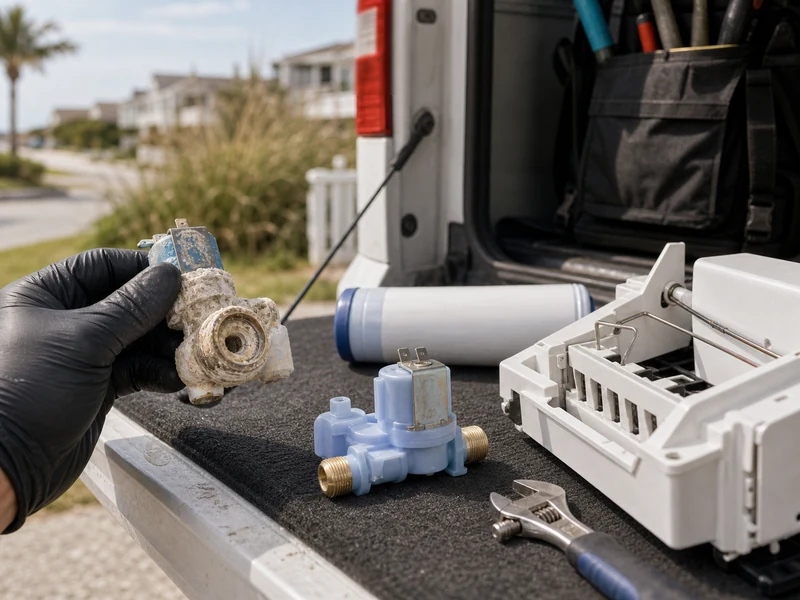
A descale is not a mop-up; it is a measured service. We clear the cold plate and the full water path, verify the inlet valve still meters to spec, check the pump and drain, fit a fresh filter so the rebuilt path is not fed by a spent cartridge, and watch full harvests before the van moves. The broader ice-maker process lives on the ice maker repair page, and the no-ice triage you can try first is on the no-ice page.
The undercounter lineup at a glance
The undercounter family shares a compact form factor and the same beach failure modes, but each type has its own weak point on this coast.
| Unit type | What it does | Local weak point |
|---|---|---|
| UC-15I ice machine | Clear restaurant-style ice on a cold plate | Scale on the plate and water system |
| UC refrigerator drawers | Refrigerated drawers in islands and bars | Salt-fouled condenser, drawer gasket |
| UC freezer drawers | Freezer drawers under the counter | Airflow, defrost, hardened gasket |
| UC beverage / wine units | Bottle and can storage at serving temps | Door seal and humidity on glass fronts |
| Outdoor / patio undercounter | Any of the above in a summer kitchen | Salt corrosion outside, scale inside |
Whatever the unit, where it sits decides half the diagnosis — an indoor island unit and a Beach Avenue patio version of the same model fail in different ways. Glass-front beverage units share the fogging story on our condensation page.
Undercounter service, beach edition
These units hide in islands and on porches, so the diagnosis often starts with where they live, not just what they do.
Educational diagnostic scenario
A UC-15I in a Neptune Beach summer kitchen, one block back from the ocean: ice had gone cloudy over a season, then production halved. The cold plate was furred with scale and the condenser fins were salt-corroded from patio exposure. A food-safe descale cleared the plate and water path, the condenser was brushed and rinsed, the inlet valve tested to spec, and a fresh filter went in. Clear ice and full production returned within a day, with a quarterly schedule set so the next season does not repeat the call.
One town south the picture is identical — Neptune Beach patios and butler pantries run the same undercounter units, covered the same week on the Neptune Beach page. When a drawer unit's trouble turns out to be a cooling fault rather than scale, the diagnosis shifts to the refrigerator repair page.
Keeping an undercounter unit off the repair calendar
Compact units reward a calendar more than almost anything else in the kitchen. Run this and most undercounter failures never arrive.
- Descale the UC-15I every three to six months. Not the longer interval inland water allows — our supply is near the top of the Florida scale. Cloudy or slow ice is the early warning; descale then and you clear the plate before scale reaches the valve and pump.
- Brush and rinse outdoor condensers quarterly. Patio and summer-kitchen units take salt outside and scale inside. A condenser brush and a rinse on the salt-air rhythm slow both, and stop a salt-coated coil from overworking the compressor.
- Change filters and check the drain on schedule. A fresh filter every six months protects the water path on this hard water; clearing the gravity drain or testing the condensate pump keeps the floor dry and the unit healthy.
The full rhythm for every appliance at the beach is in our salt-air survival guide, and the hard-water details across all makers are on the ice maker repair page.
Quick answers
Undercounter questions we field all summer
Is the UC-15I the only Sub-Zero ice machine still made?
It is the one undercounter ice machine that has stayed in the lineup since 2009, and on the beaches it is the one we see most. The UC-15I makes clear, restaurant-style ice by running water continuously over a cold plate, then harvesting a sheet and cutting it into cubes. That continuous water contact is exactly why hard JEA water hits it harder than any other unit in the house — scale is its number-one local failure.
Why does my UC-15I make cloudy ice or slow down?
Both are the scale signature. At 14 to 28 grains per gallon, minerals build on the cold plate and through the water system, insulating the freeze surface so the sheet forms slowly and traps cloudiness instead of running clear. A scheduled descale clears the plate and water path; if production has been declining for months, the inlet valve and pump may also need attention. We measure rather than guess before naming a part.
Can a patio or summer-kitchen undercounter unit survive the salt air?
Yes, but it needs a schedule. An undercounter refrigerator, beverage drawer, or UC-15I out on a Beach Avenue patio fights scale on the inside and salt on the outside at once — corroded condenser fins, pitted fasteners, and a compressor working overtime to reject heat through a coated coil. A quarterly rinse and a condenser brush, the same rhythm in our salt-air guide, is the cheap defense that keeps a patio unit out of the expensive lane.
My undercounter unit drains onto the floor — what is wrong?
On undercounter ice machines and drawer units, a puddle usually means the drain path, not the cooling system. Many installs use a gravity drain that clogs with scale or biofilm, and some retrofits rely on a condensate pump that fails or loses its line. We trace the water to its source — gravity run, pump, or a split fill line on this hard water — rather than just mopping. Most drain jobs land in the lower cost lanes once the path is clear.
How often should I descale a UC-15I on Atlantic Beach water?
More often than the manual assumes for inland water. On 14-to-28-grain JEA supply, a food-safe descale every three to six months keeps the cold plate clear and the ice running clean; outdoor and high-use units lean toward the shorter end. The early warning is cloudy or slow ice — descale at that stage and you clear the plate before scale reaches the valve and pump, which is where the bill grows.
Do you service undercounter refrigerator and freezer drawers, not just ice?
Yes — the UC refrigerator drawers, freezer drawers, and beverage units all share the undercounter platform and the same beach failure modes: salt-fouled condensers, hardened drawer gaskets, scaled water paths on the units that take a water line, and the occasional control or thermistor fault. They tuck into islands, butler pantries, and outdoor kitchens around here, and they get serviced in place with the cabinetry untouched.
Is a whole-house water softener worth it just for the UC-15I?
It helps the whole house, not only the ice machine — and on this hard water that is a real argument. A softener drops the mineral load reaching the UC-15I, every fill valve, and every filter, stretching all of them between services. The caveat is that very soft water tastes flat to some people and the softener needs its own upkeep. For most beach homes, scheduled descaling plus six-month filters protect the ice machine for far less, and we will give you the straight trade-off rather than a sales pitch.
Why is my undercounter unit freezing up or running warm in the cabinet?
A drawer unit running warm or icing usually points at airflow or a tired gasket, both made worse by where these units live. Built into a cabinet with limited ventilation, a salt-fouled condenser cannot shed heat, so the compressor overruns; a hardened drawer gasket lets warm, humid room air in, which freezes onto the coldest surfaces. We check airflow and the seal before anything else — the cheap causes are also the common ones on this coast.